



Have a think about your last vacation. (I’ll use the North American term here. Fellow Brits, as well as Aussies and Kiwis: we’ll think about our last holiday.)
Was it primarily enjoyment? Or was it more recovery?
For most Great Work readers—we’re people who do tough, meaningful work, and tough work is tough—it may have been a bit of both. So put it on a scale: where on this scale did your last vacation sit?
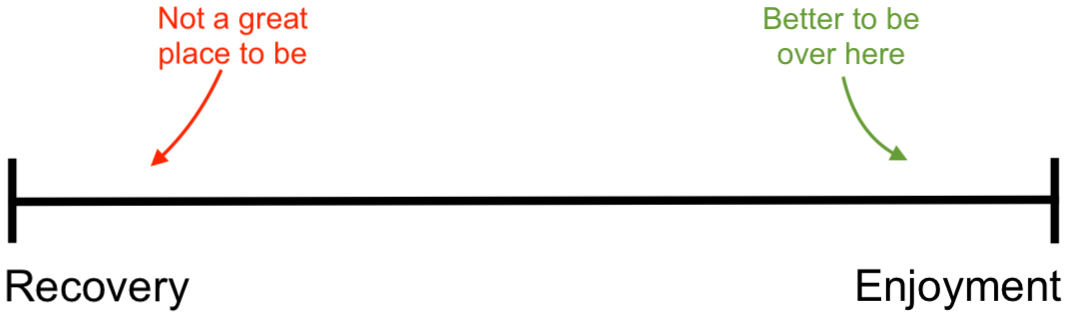
This is vital information. Where your vacations fall on that recovery-enjoyment scale is a measure not of the vacation but of the state of your life. This is a great stepping-back-and-seeing-the-big-picture indicator of how your life is going.
If your vacation’s on the enjoyment side of the scale, that’s a sign that things are in balance.
If your vacation’s on the recovery side of the scale, it’s an important indicator that they aren’t.
If you’re needing vacations to recover, something’s wrong.
For a start, using vacations to recover may not work. Sure, you’ll feel better at the end of it. But the wellbeing bump is short-lived—one study of German teachers found it lasted less than a month ; in another small but more diverse study in Austria, less than a week.
That needn’t depress us: there’s evidence that, in the longer run, vacations may make us happier, healthier, and better protected from burnout.1 There’s even (weak) evidence that more frequent vacations may help you live longer. (This weighs heavily in the US, with some of the shortest vacation allowances in the world and culture of not using all of it.)
Vacations are great.

But, if you’re relying on vacations for recovery, you probably aren’t leading the life you want to lead. And you’re missing out on one of the great pleasures of life—vacation for enjoyment.
The problem and the solution
So you can use your vacation to recognize when things aren’t as they should be. Is it mainly enjoyment, or mainly recovery?
And if you can’t take a vacation, this works just as well in hypothetical form: if I did, would it be enjoyment or recovery?
That vacation test will tell you that something’s wrong, but it doesn’t tell you what to do about it. But one of the defining characteristics of a great vacation is that it offers time and space for mulling things over: it gives you perspective. The vacation itself (if you can get one), even a recovery vacation, is the ideal time to think about what’s wrong, and what you want to do about it—with a clarity about what really matters and how good and bad things are that’s elusive when you’re cognitively overloaded and exhausted.
Is yours a bad job? Should you leave?
Or are you giving too much of yourself to your work?
Do you need to get better at managing your time?
Is this something to do with how you’re reacting to things?
Do you need to prioritize rest better during your working life, not just on vacation? (I wrote more about this here.)
Do you need to make a big career decision?
Do you need to get some advice? (Email me! I’ll gladly mull it over and give you my thoughts.)
And if any of the ideas above ring true, click on the links: you might find an answer there.
P.S. It makes my day to hear from a Great Work reader. Just click ‘reply’: it’ll come straight to me.
New here? Not yet signed up? Sign up! It’s free, practical, evidence-based, never spam, and bullshit-free. ⤵
And, if you find Great Work useful, please do share it with others who might like it too. Thank you! ⤵
Are you a LinkedIn person? ⤵
For an excellent summary of the research, see the chapter on “Recovery” in Alex Soojung-Kim Pang’s Rest: Why You Get More Done When You Work Less (New York: Basic Books, 2024), a book I will never stop recommending.
I lived in Lake Tahoe and a neighbor had a bumper sticker on their car that said “My Life is better than Your Vacation!” I try to live this way, and a vacation in Tahoe is pretty great. 😻
It’s a holiday! What’s happened to you?! Another test would be who’s got time to read blogs. I pass them all 🤘🤘