



Remember being seven years old and wanting to be outside, playing with the other kids? Homework and chores were things you did only because you had to — you’d have happily skipped them. You could have fun free from guilt about responsibilities elsewhere.

Hold onto that memory for a moment, and consider whether any of the following situations are familiar from your life now:
You’re having a heavy day at work. You’d love to escape, to go for a walk to breathe and clear your head — but you have too much to do. So you plough on, working less and less effectively.
Or: it’s the end of the day and everyone else has left your workplace. But you have some stuff you need to get done, and you don’t want it hanging over you. So, rather than heading home and tackling it another time, you stay late to finish it (and are exhausted the next day).
Or: after a tough week at work, it’s Saturday morning. And you have a list: laundry, cleaning, shopping, the tax return, the passport renewal. You start tackling the list so that, once everything’s done, you’ll be able to unwind without guilt. Only — the chores somehow expand to fill the weekend and, on Sunday night, you realise you did nothing to relax.
If you recognise yourself in any of these scenarios, there’s something to learn from your seven-year-old self — something I’m going to show you can be deployed intelligently to allow you to work better, and enjoy life more.
What’s going on here?
There’s a big difference between this responsible, adult you and the seven-year-old you. Something changes when we’re teenagers.
There was a moment, when I was seventeen, in my final year of school, when I decided I really wanted to get into Oxford University. In those days, Oxford had a competitive entrance exam. I’d got through previous exams by relying on the seat of my pants and a good memory for facts — with what I’ll now call mixed success. But this time, for the first time, I drew up a revision plan, settled into a corner of a library, and worked. No-one told me to. No-one pressured me to apply to Oxford: that was me. Even I could see, with all the emotional intelligence of a seventeen-year-old boy, that something in me had changed. (And the work paid off.)
Psychologists identify a shift from external pressure (“You’re not going out to play until you’ve finished your homework!”) to internalised pressure (“If I don’t empty my inbox now, tomorrow’s going to be worse”).
Great Work readers, those of us who’ve worked hard to get into jobs we care about, may have particularly well-developed internalised pressure and discipline. We have to. And we’ve had years of training ourselves to do our homework when we’d rather be playing outdoors. We’re prone to overshooting — the adult error. We become over disciplined, and disregard the crucial importance of rest.
Why this matters so much
I’ve written before about the effort–results bell-curve, the relationship between how hard we push ourselves and what we achieve.

The harder you work, the more you get done, up to a point. We all think we’re at A, to the left of the peak (B), because we believe that, if we push ourselves a little harder, we’ll get more done.
But large amounts of evidence from a wide variety of perspectives suggest that most of us, most of the time, are at C.
And the interesting thing about being at C is not just that you’re not working at your optimum. It’s that, if you want to do better, the only way to do that is to push yourself less hard.
What’s the solution?
Our jobs push us to the right side of that bell-curve. But, as the scenarios above illustrate, we push ourselves further to the right. In that child–adult shift from external to internalised motivation, we overshoot.
The heavy day at work when you want to take a break but, instead, plough on? Plenty of research indicates that, if you took a short break, cleared your head, moved your body, maybe got some fresh air, then, as well as feeling better, you’d work more effectively afterwards. It’s more efficient to have a break, and then return to work, than it is to plough on. On the bell-curve, you move yourself from C to B.
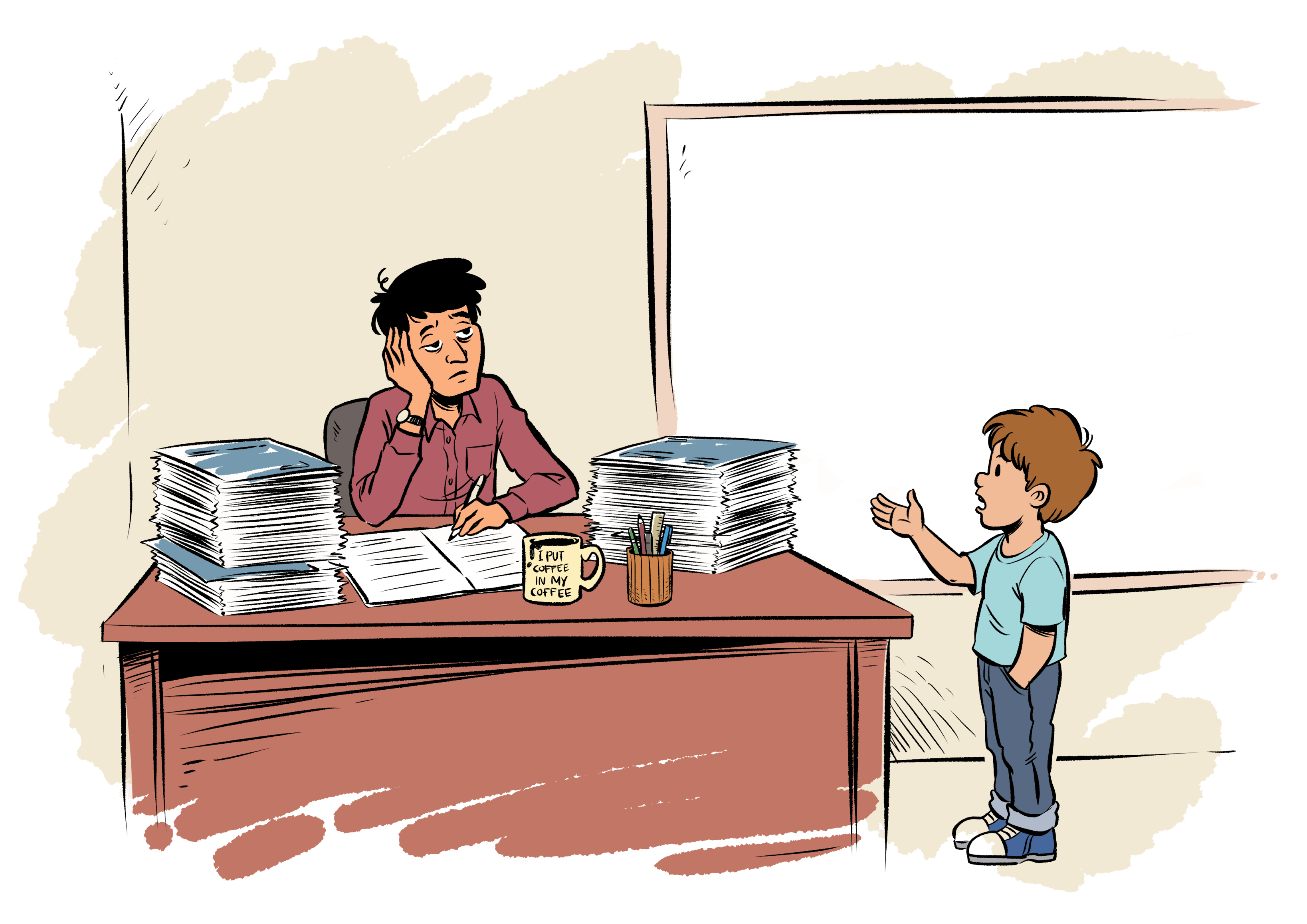
The end of the long day when you stay at work to tackle lingering tasks? Go home. Have a relaxing evening and a good night’s sleep. When you turn to those tasks the next morning, you’ll get through them more quickly, making less of a meal of them, and make better decisions. On the bell-curve, you moved yourself from C to B. (You may need to modify this if you’re night owl, not a morning person — but you get the idea.)
The Saturday morning with your list of chores? Take Saturday off, and spend it relaxing and resting. Read a book. Go for a walk or a run. Spend time outdoors. Spend time with people who make you feel good. The things that truly need to get done you can do on Sunday: they’ll contract to fit because, within limits, that’s what tasks do. And you’ll do them with more energy, a clearer head, and a time-limit.
But I just need to finish this!
This approach involves recognising the vital importance of rest, learning to take it as seriously as professional athletes do when they’re training for a competition. It’s at least as serious for you.
This requires cultivating an acceptance of things being left undone. As the writer Oliver Burkeman has observed, you are never going to clear the decks. The sooner you learn to live with that, the better — and more productive — your life will be.
And if, as I seem to have done, you have so trained your discipline muscle that your instinct is always to do the responsible things first, at the cost of rest and enjoyment — if you can’t be seven years old any more — then try this. Mentally recategorise rest and enjoyment as chores, as responsibilities, as duties you must discharge to optimise your performance (as well as your earnest worthiness). At least, that way, you’ll make it happen. And you’ll feel better, too.
Time management
Hear me discuss some of this stuff with the amazing Laura Vanderkam, author of possibly the best time-management book I’ve come across, Big Time: A Simpler Path To Time Abundance, on her Before Breakfast podcast (which I’d recommend even if you don’t want to listen to my mellifluous tones). Apple Podcasts, Spotify, web.

Imposter syndrome article
80,000 Hours is an organisation that helps people figure out how they can do the most good with their careers.
Luisa Rodriguez, who hosts their podcast, has written this wonderful article about imposter syndrome. It’s full of good advice.

Sabbatical book recommendation
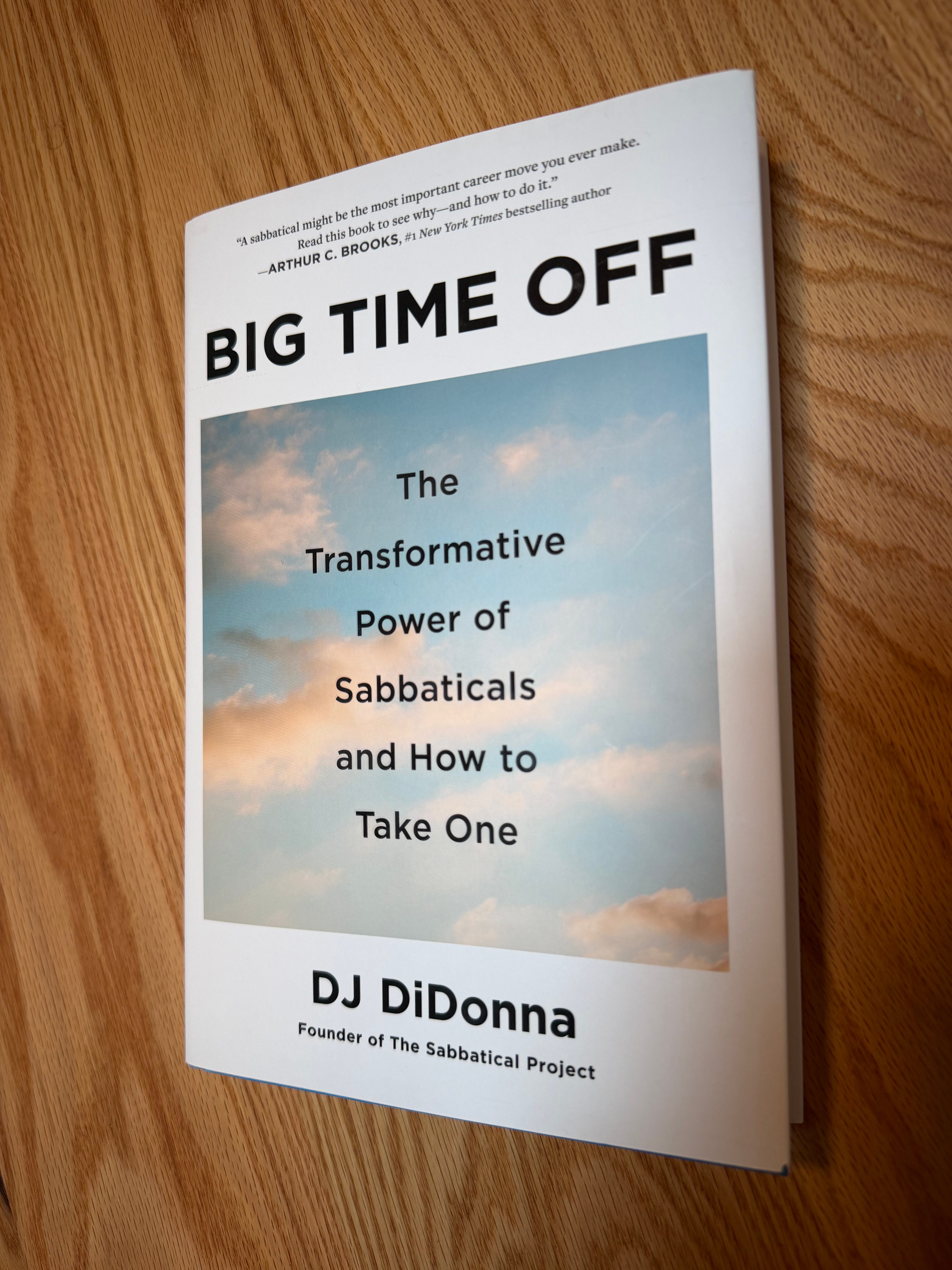
A book recommendation for you: DJ DiDonna (dj didonna)’s just-published Big Time Off: The Transformative Power of Sabbaticals and How to Take One (New York: Simon Acumen, 2026).
Have you ever thought you might like to take a sabbatical? If you have — or if you haven’t! — I’d highly recommend this. I wondered whether there was really a whole book in this topic: it turns out that there is. It’s a great read, and manages to combine thoughtful stories about how people have approached their sabbatical with clear, practical advice. And it recognises that travelling around the world for a year isn’t an option for everyone.
I’ve taken two short sabbaticals in my career, including one recently to work on the Great Work book. I’d have done both way better if I’d first read this book.
P.S. Replies come straight to me, and I love hearing from people who read this. Do let me know your thoughts!
P.P.S. Really short feedback survey helps me improve these—if you have a moment.
P.P.PS. The last one of these, in case you missed it: What if the answer to stress were just a perspective-shift?
New here? Not yet signed up? Sign up! It’s free, practical, evidence-based, never spam, and bullshit-free. ⤵
The podcast version of Great Work is available on Apple Podcasts, Spotify, and YouTube. It’s now professionally produced.
And, if you find Great Work useful, I’d be so grateful if you were to share it with others who might like it too. Thank you! ⤵
Upcoming conferences (for teachers)

researchED is a wonderful, international conference for teachers who want to use good evidence to teach better. I’ll be at the researchED UK National conference in London on 5th September 2026 and at researchED St Louis (USA) on September 26th, 2026—speaking about how teachers can have better working lives, because there’s good evidence that wrung-out teachers leave and that teacher turnover harms learning.
AI writing statement: I write every word.