



What if the problem with stress weren’t the stress but, instead, our attitude towards stress—and, if we just start thinking about it differently, our pressured lives would be transformed?
This is the claim of stress mindset theory, a thread of serious academic psychology. The theory’s enthusiasts suggest that stress can be good for us, makes our lives richer, and is something we can learn to exploit.
That’s a bizarre claim. But it’s also intriguing.
So I want to look at what this is all about, unpick the evidence that a stress mindset approach can make a real difference to those of us with stressful working lives, and tell you about my own experiments with it.
And if you want to know where I’m going with this, here’s what I conclude: stress mindset strategies aren’t magic. Chronic stress is terrible for you. The scope of stress mindset theory has been over-hyped. But there is something here that’s useful in real life, that’s grounded in solid research, and that may genuinely help you in stressful situations.

What is mindset?
You may have heard about mindset psychology. Mindsets are self-fulfilling beliefs about ourselves and how things affect us. Best-known may be growth mindset, a term coined by Stanford psychologist Carol Dweck: this is the idea that those who believe that their intelligence and skills can grow are more successful than those who believe they’re stuck as they are (a fixed mindset). You can, the idea suggests, shift from a fixed mindset to a growth mindset. Dweck popularised this in her book Mindset: The New Psychology of Success. If you’re a teacher, you almost certainly already have an opinion about the usefulness of growth mindset as a teaching tool.
There are all sorts of other interesting examples of mindset. People with a positive attitude towards ageing may age better and even live longer than those who dread getting old. There’s the placebo effect—often more powerful than the pharmacological benefits of medications. And in one wonderful experiment, people who were given the same milkshake had a dramatically different ghrelin response—the ‘hunger’ hormone—depending on whether they were told it was high-calorie and “indulgent” or that it was low-calorie and “sensible”.
If, like me, you’re fascinated by this whole line of psychology, there’s a fantastic book by science writer David Robson called The Expectation Effect that will change how you think about your experience of life.
There’s no doubt that what we believe does often affect how we experience things. You’ve probably noticed this in your own life. There was a pattern I spotted when I was a lawyer: how well I did in court seemed disconcertingly influenced by how confident I felt walking in. Of course, my confidence was shaped partly by the strength of my client’s case. But sometimes my client’s case was objectively terrible but I knew I was as well-prepared as anyone could be, and so felt good not about the case but about my role that day—and, to my astonishment, would pull an unexpected victory out of the bag. And sometimes it would work the other way. So I learnt to get myself in the right frame of mind before each hearing, and I’m pretty sure it helped.
So what about stress mindset?
Well, the research distinguishes two stress-related mindsets. The one most of us have, heavily reinforced by our culture, is that stress is bad for you. It depletes you. It makes you function worse. It’s horrible. It’s something to be avoided. This is called a stress-is-debilitating mindset.
There’s an alternative, though: the stress-is-enhancing mindset. This is seeing stress as a sophisticated, adaptive response that can improve your performance. It helps you handle challenging situations. When you’re stressed, you’re more likely to learn and grow. And a life with some stress is a more meaningful life.
These are each self-fulfilling prophecies, says stress mindset theory. And it looks as though it’s easy to switch yourself from a stress-is-debilitating mindset to a stress-is-enhancing one. More on that in a moment.
Right next to the stress mindset approach is something called stress arousal reappraisal. This is about changing how you react to the feelings of stress—anxiety, for example, or noticing your heart’s beating faster. Instead of feeling overwhelmed by those feelings, you recognise them as part of something that may help you rise to a challenge. Stress arousal reappraisal is so closely related to stress mindset that, here, I’m treating them as two lenses of the same sunglasses.
So can this actually help me?
I’ve spent a lot of time delving into this, because I do jobs that can be intensely stressful and, if anything can truly help me and others navigate this kind of work more easily, I want to know. The idea that a simple shift in my mindset could make a difference is appealing, and a lot easier than finding that elusive, perfect, stress-free yet fulfilling job. And there is something in the observation that a life free from all stress would be one with little meaning, that the stressful times in our lives are often also times of growth.
But I don’t think it helps anyone to find an idea and sell it to you as a perfect, effortless solution to life’s big challenges without considering the evidence.
So what does the research actually say?
First, a health warning. The strongest advocates of the stress mindset approach sometimes overstate the benefits of stress. It’s simply not true to say, unqualified, that stress is a good thing. Chronic stress is horrible, and terrible for our health. And of course that disproportionately affects people with bad jobs, people in poverty, people being abused. It’s important to be really clear that there’s nothing good about grinding, ongoing stress. I’m writing here about periodic challenging situations that don’t last for ever.
Second, the suggestion—also sometimes voiced by stress mindset proponents—that stress is bad for your health only if you expect it to be bad for your health doesn’t hold water. For example, one huge study did indeed show an association between your beliefs about the effects of stress on health and your health (and even how long you live). But that was an observational study. Correlation doesn’t prove causation. There’s a good alternative explanation: that if you experience stress and take it in your stride, that leaves you believing that stress isn’t harmful while, if you are harmed by stress, it leaves you believing that it is harmful. It’s important not to be carried away by mindset theory.
And my third reservation: it’s an easy, lazy jump from “Our stress mindset affects how we experience stress” to “There are no stressful jobs, just stressy people.” There definitely are stressful jobs, and the research suggests that employers who want healthier, higher-functioning employees need to focus not on fixing their employees but on fixing the jobs they offer.
However, there is something in the stress mindset perspective. There’s a growing body of evidence that stress mindset-based approaches do make a genuine difference. Some of the research into this has used impressively small interventions—three-minute videos, for example—to shift people from a stress-is-debilitating mindset to a stress-is-enhancing one. Those brief interventions result in measurable changes to people’s mindsets, improved psychological wellbeing, and people feeling better when exposed to challenging situations. They’re also more mentally flexible and even have better-adapted stress hormone responses. A recent meta-analysis (a powerful synthesis of lots of other studies) suggests that strategies to change people’s stress mindset and how they react to the feelings of stress make a real difference. Not a huge difference. But a meaningful one.
So yes, this can actually help you. And that’s my own experience too. Trust research more than anecdotes. But here’s what I’ve found. On those stressful days at work when I’ve started to notice myself feeling stressed I’ve made a point of reminding myself that this may be helpful, may energise me, may help me rise to the challenge. And I think it makes a difference. It’s even, sometimes, helped me shift from feeling overwhelmed to actually enjoying it.
I’ve had another opportunity to test this out because I’m increasingly speaking to sometimes large audiences about this Great Work stuff. Often, beforehand, despite having done a lot of public speaking over the years, there’s a restless, heart-pounding nervousness. I used to read it, in the moment, as a sign that Great Work and I were charlatans. But now I think: no, this is me energising myself for what I’m about to do. Welcome, stress response. And I think that helps me do better.
How do I start?
If you think there might be something here for you (and it’s easy to try) there are a couple of places you might go for more.
Much of this research has been done at Stanford University, and their Mind & Body Lab (run by Alia Crum, the doyenne of stress mindset) offers a free, online Rethink Stress Intervention. It takes an hour or less; I’ve done it; it’s good.
And there’s a book on this, Kelly McGonigal’s The Upside of Stress: Why Stress Is Good for You, and How to Get Good at It. It’s well-written, and helpful if you want to try this stress mindset approach on. The downside of The Upside is (in my view) that McGonigal oversells the evidence, in some of the ways I’ve outlined above. But, if you’re reading it to help get yourself into a stress-is-enhancing mindset, that may not matter.
Remember, the evidence suggests that it may not take much to shift your mindset. And a recent paper suggests that having some understanding of the whole mindset approach (which I’ve tried to share here) may make that shift more effective and more durable. If you just want to watch those three-minute videos, they’re on Stanford’s website too (where they’re eerily called ‘manipulation’ videos, because they were research tools). But I wonder whether reading this article (which took you more than three minutes) may be enough.
What was I trying to do here?
It seems as though, to be successful writing about this stuff, you have one big idea that you package as a miraculous, easy solution to a common problem, and hype it everywhere you can—TED talks, social media, a newsletter that, after a while, starts to feel repetitive.
There isn’t one big idea that’s going to transform your life, or mine. If there were, we’d already know it. We’re all continuously learning. There are lots of ideas from which we can all benefit. They’re what I write about here. Some of them, like this one, stress mindset, are genuinely useful. And if we’re serious about improving our working lives and the good we’re able to do with them, it’s important that we do that in a balanced way, following the evidence—and that we don’t blame people for their struggles. Tough work is tough.
P.S. Replies come straight to me, and I love hearing from people who read this. Do let me know your thoughts!
P.P.S. Really short feedback survey helps me improve these—if you have a moment.
P.P.S. The last one of these, in case you missed it: I made a medical error.
New here? Not yet signed up? Sign up! It’s free, practical, evidence-based, never spam, and bullshit-free. ⤵
The podcast version of Great Work is available on Apple Podcasts, Spotify, and YouTube. It’s now professionally produced.
And, if you find Great Work useful, I’d be so grateful if you were to share it with others who might like it too. Thank you! ⤵
Meet me at a conference!
Workplace Mental Health Conference
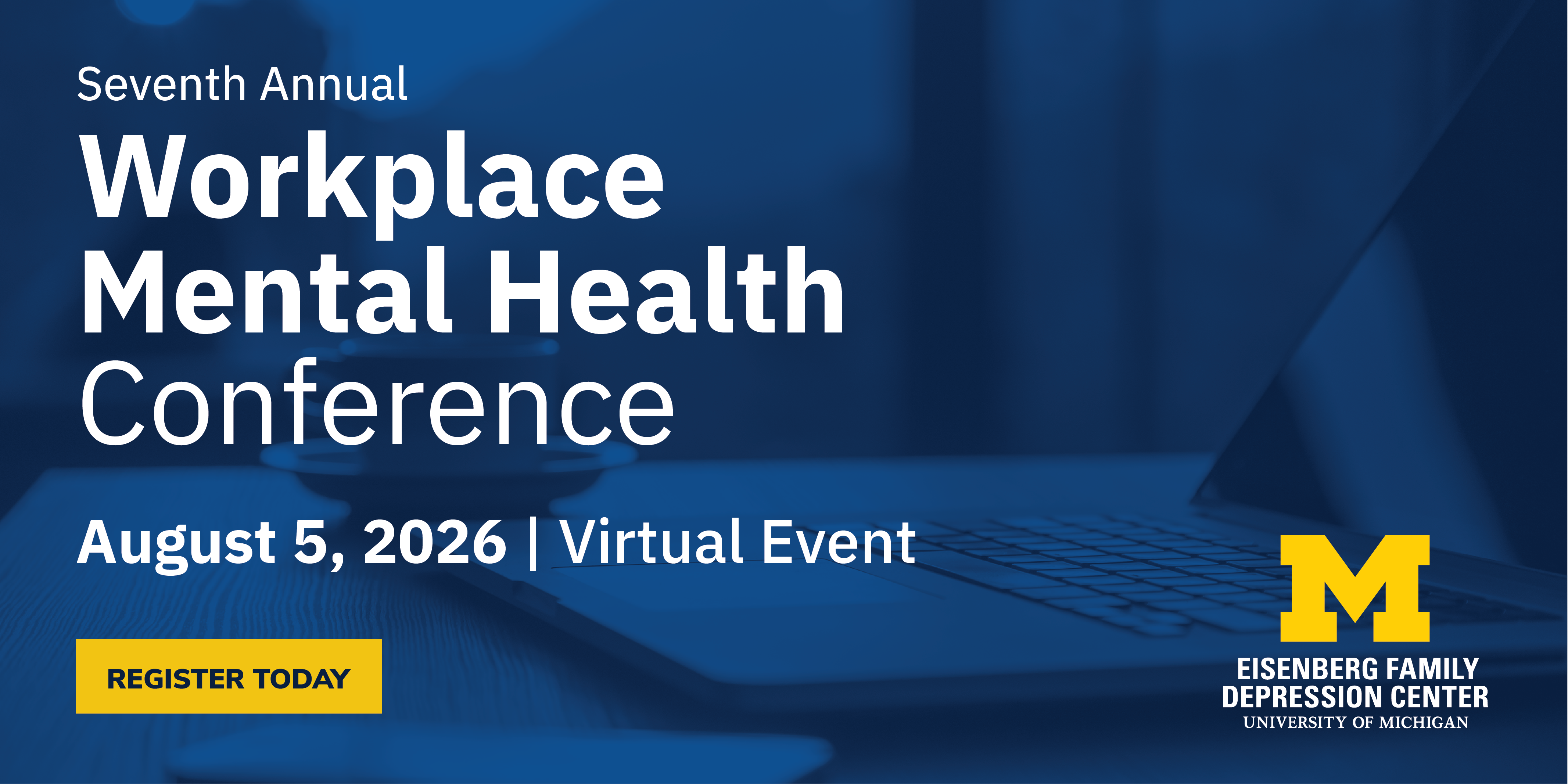
The University of Michigan (Eisenberg Family Depression Center)’s virtual half-day conference on workplace mental health focuses on how organizations can better support employee well-being and success. August 5th, 2026. A great lineup of speakers (plus me). I’ll be talking about emotional regulation at work—what can employers actually do? Conference info here.
researchED

researchED is a wonderful, international conference for teachers who want to use good evidence to teach better. I’ll be at the researchED UK National conference in London on 5th September 2026 and at researchED St Louis (USA) on September 26th, 2026—speaking about how teachers can have better working lives, because there’s good evidence that wrung-out teachers leave and that teacher turnover harms learning.
AI writing statement: If it has my name on it, I wrote every word.
Hey Adam, this is a lot of the work that I do so I have lots of thoughts, but I'll just burden you with one-ish.
Part of the issue with mindset work is that there is no such thing as "Stress is..." Instead, imagine if we replaced the word stress with actual events and then the mindset approach must get much more nuanced:
"Studying late and having take high pressure tests is....enhancing!"
"Having to work 2 jobs to care for both my children and my sick mother is....debilitating"
Both can be true. Thus the difficulty of prescribing a particular mindset to people. I like to think more in terms of reappraisal because reappraisals can be contextualized differently to each stressor and person and we've identified when they are more useful (middling intense stressors with alternative perspectives) and when they're less useful (highly intense stressors that we have to do something about).
Thanks!
Christian
Oh this is brilliant. I'm going to have to sit with this a bit, let it cogitate, and maybe get back with you later.